

How Pitas communities replant mangroves to reclaim their heritage
Mangroves are haltingly returning to land devastated by a giant shrimp farm, but for locals, recovering the forest is about more than planting trees; it’s a matter of heritage. | Photo: a hurt land by Arieff Zafir
Writer: Liani MK | Photographer: Arieff Zafir
Editor: SL Wong
Cartographers: Louis Lugas and Irma Garnesia
File photos: Chen Yih Wen
Published: 23 September, 2026
This is a #BLUECARBON story, part of the Macaranga Project on Climate Disinformation and Indigenous People.
How Pitas communities replant mangroves to reclaim their heritage
Mangroves are haltingly returning to land devastated by a giant shrimp farm, but for locals, recovering the forest is about more than planting trees; it’s a matter of heritage. | Photo: a hurt land by Arieff Zafir
Writer: Liani MK | Photographer: Arieff Zafir
Editor: SL Wong
Data visualisers & cartographers: Louis Lugas and Irma Garnesia
File photos: Chen Yih Wen
Published: 23 September, 2026
This is a #BLUECARBON story, part of the Macaranga Project on Climate Disinformation and Indigenous People.
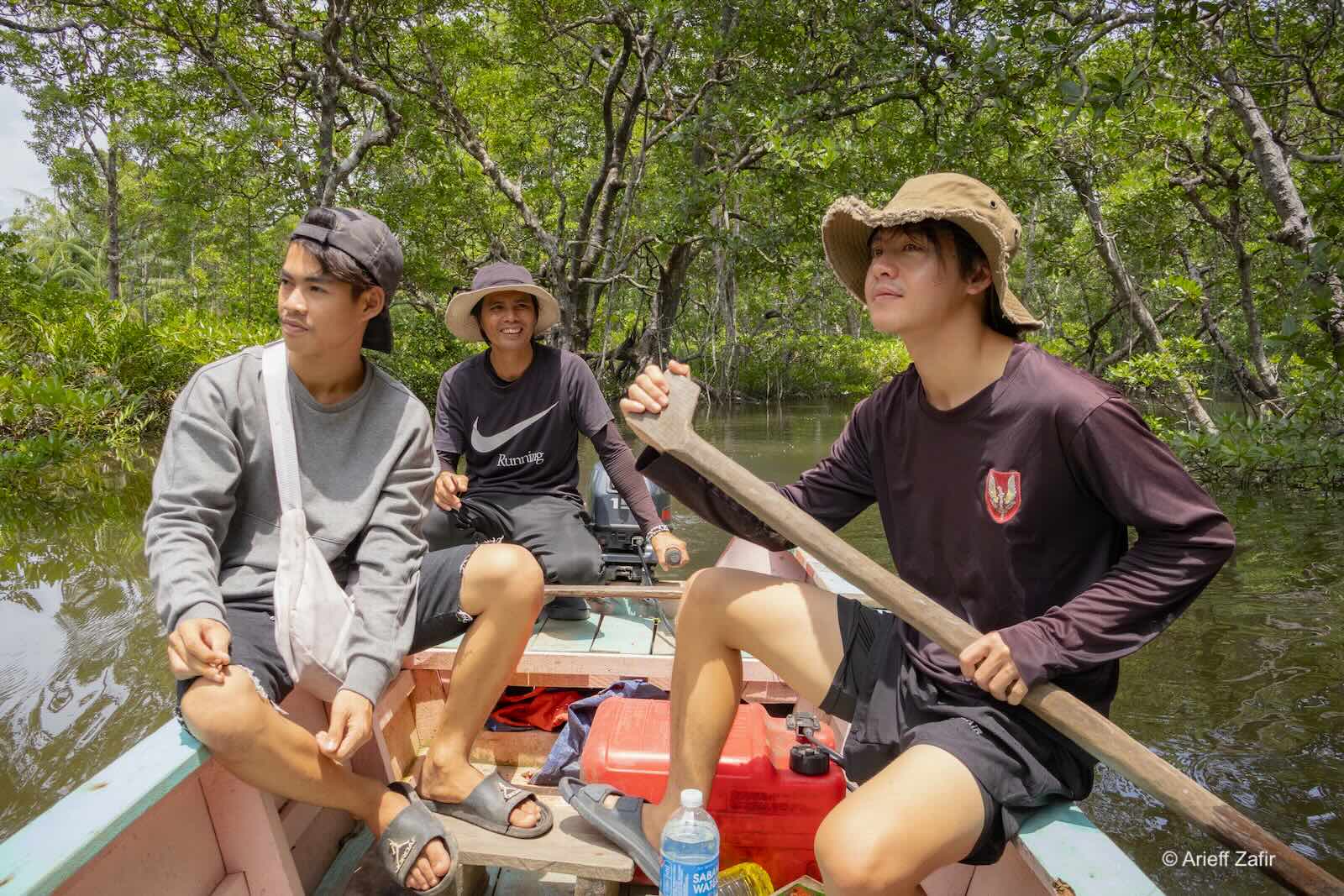
EVERY FEW DAYS, a few villagers would start their boat engine and travel along the brown murky streams that connect to the Telaga river in Pitas, Sabah. The waterways are lined with mangroves which are alive with the sound of nginit or crickets even at mid-day. Yet the tidal water flowing through the mangrove’s dense root systems is calm.
Sometimes, a distance away in the thick of the forest, pot-bellied Proboscis monkeys (Nasalis larvatus) are spotted munching on mangrove shoots.
The villagers reach a site where healthy mangroves once thrived but were destroyed by a giant aquaculture project 10 years ago. Here, they will replant seedlings they collected.
They had started planting in several areas soon after the mangroves were logged. Finally, parts of this one site look like a recovering forest. The vegetation is dense enough that the project feels like a distant memory. Except that the site still has abandoned ponds and patches where the mangroves struggle to grow.


The giant shrimp farm spread ponds over hectares of former mangroves; after the Covid-19 pandemic, it was a wasteland, pictured here in 2023. Read our photo essay from that period. (pics: Chen Yih Wen).
Pitas is one of the poorest districts in Malaysia. It has the highest absolute poverty percentage at 50% in 2024, and limited access to clean water and reliable, affordable electricity.
Economic injection was critical. In 2014, the Sabah government launched a RM1.23 bil Pitas Shrimp Park mega-project, which was at the time set to be Malaysia’s largest commercial shrimp aquaculture development.
The project was announced as a poverty eradication initiative promising more than 3,000 jobs to rural communities. It was run by Sunlight Inno Seafood Company Sdn Bhd, a joint venture with Yayasan Sabah’s Inno-Fisheries, owned by the Sabah state government.
But one year before its launch, developers cleared around 930 ha of mangrove forests, even before the approval of the Environmental Impact Assessment (EIA). The 2,000 villagers across 6 villages were not consulted, various community members told Macaranga.
THE INDIGENOUS Tombonuo, Rungus and Suluk communities here have fished and farmed along Pitas river and its surrounding waterways for 9 generations. Here, in the mangroves’ shallow tidal waters, the communities fish, forage and harvest plants for traditional medicine.
They value these waters as critical breeding and feeding grounds for marine life, including fish, prawns, crabs and molluscs. What’s more, the coastal mangroves protect the lands of upriver communities from storms and erosion.
Customary areas affected
The shrimp farm destroyed roughly 76% of their customary forests, said indigenous rights NGO PACOS Trust. PACOS has mainly supported one of the villages, Kampung Sungai Eloi, since 2010 in documenting and strengthening customary governance of their territory.
Sunlight Inno Seafood Company did not respond to Macaranga’s request for an interview.
Then the farm ceased operations during the COVID-19 pandemic, and has not resumed operations till the present. There were no more jobs. What remained was degraded pond mud, broken fences and decimated mangroves. The community had spent years watching their river ecosystem destroyed. Fishers had lost 70% of their catch.


The planting efforts of locals such as village collective head Mastupang Somoi are replenishing the land. The photos from roughly the same location show seedlings planted during low tide in 2023, grown into small trees in 2026, photographed during high tide. (Pics by Chen Yih Wen [2023] and Arieff Zafir [2026])
Planting Using Traditional Knowledge
BUT EMERGING from that forest clearing was community action. Kampung Sungai Eloi and the other 5 villages banded to form a collective calling themselves G6. Their goal was to protect whatever mangroves remained and to rehabilitate the rest.
In 2016, the G6 started replanting mangroves in destroyed community areas outside the aquaculture project. In the following 2 years, they painstakingly planted a total of over 5,000 seedlings on 3 sites covering 4.5 ha. They have been caring for the plants and slowly enriching the patches since then.
The mangrove planters estimate survival rates of 60–80%, but admit there is no formal documentation or audits. In fact, there isn’t even a budget.
Hard to regrow
In mangrove replanting programmes across Southeast Asia, survival rates of 10 to 20% are common when there is limited natural regeneration; rehabilitating degraded and destroyed mangroves is very difficult.
The going is slow because the planters do everything themselves, including fundraising for planting, monitoring and patrolling activities.
What is crucial though is that they have been rehabilitating their mangroves using their inherited traditional knowledge of the wetlands.
Noridah Samad is a Tombonuo who leads the Customary Land Claims Committee of Kampung Datong, a G6 village. She explains, “We know that when you plant panggang, it depends on the moon and stars. Because they determine the pasang surut (ebb and flow of tides) and indicate the monsoon seasons.” Panggang is Tombuono for mangroves.
The villagers also know when the elongated seeds of the mangrove fall and which species belongs to which tidal zones, so the right plants can be planted in the right areas.
Mimicking nature
Planting only happens with what the river itself provides. So as their boats travel along the rivers, they collect whatever propagules there are from the water and riverbanks.
Then, the collected propagules are placed into polybags filled with a nutrient-rich mixture of local mud, sometimes clay and sand.
These bags are organised into seedbeds in temporary nurseries designed to mimic a natural tidal environment. Some temporary nurseries are built in the low intertidal zone where tidal waters naturally flush through, while others are set up on land with controlled irrigation.


THE PLANTERS learned from trial and error too. Murai Euos, a G6 committee member, recalls that they used to be puzzled about the cause of some mangrove seedlings dying. “We realised [later] that is what the Proboscis loves to eat!”
So, the villagers plant more mangroves to ensure the monkeys have enough to eat too.
Proboscis monkeys, endemic to Borneo and common in the community’s mangroves, primarily eat Bakau minyak (Rhizophora apiculata). “We have to think ahead for the birds or other creatures that rely on the mangroves,” says Murai.
Natural recovery
The forest also started healing naturally in places where the destruction was not so bad.
“When the shrimp farm closed during the COVID-19 pandemic, we could immediately feel the rejuvenation of our mangroves and rivers,” recalls Mastupang Somoi of Kampung Sungai Eloi.
“Even though it is not the same as before the shrimp farm, at least things are slowly recovering by about 85–90%.” The farmer and fisherman is the founder and chairman of the G6 collective.

Of the G6, Kampung Sungai Eloi villagers are the most active in rehabilitating mangroves. A year ago, instead of ad-hoc propagule collection, they started a village nursery.
Within months, they had nurtured almost 1,000 seedlings in polybags to plant within the kampung’s customary land. They are starting with 40 ha of their total 142 ha of mangroves.
“This is fully run by the community, without any external [institutional] help,” says Mastupang proudly.
Planting for wildlife
Kampung Sungai Eloi’s community mangroves were actually not cut down for the shrimp farm. So why plant here?
Mastupang said they observed how Proboscis monkeys lost their habitats after the shrimp farm destroyed those patches of mangroves. The animals therefore relocated to the Kampung Sungai Eloi area, where mangroves and food remain.
But their presence started putting greater pressure on the existing mangroves as they feed on them. “There are a lot of them! So we are also planting trees for them,” says Mastupang.


The mangrove areas devastated by aquaculture are slowly rejuvenating naturally too, but it’s a struggle as conditions have changed so badly, says Mastupang, pictured here in the same location in 2023 and 2026. (pics by Chen Yih Wen [2023] and Arieff Zafir [2026])
Customary Governance
THE COMMUNITIES’ 4.5 ha of mangrove rehabilitation seems miniscule compared to the 930 ha that were destroyed. But for the Tombonuo, Rungus and Suluk people, their mangroves are their traditional heritage, and conserving them is encoded in customary governance.
Customary territories are called puru inigoladan, and are known to every local, Noridah explains. Under adat or customary law, trespassers face a community fine known as sogit. If the accused denies the charge, the case is brought before the native court.
After the shock of the widespread mangrove clearing a decade ago, the G6 members put up signboards demarking their puru inigoladan; the signs basically state that the areas are protected by community protocol.


Olon Somoi, Mastupang’s younger sister and one of the women who fought for the communities’ rights, says, “We’re only prohibiting people (or outsiders) from destroying the area. The community can still enter to fish and find resources.”
This determination to reinforce their territorial rights came about after the aquaculture project debacle. Not only were the mangroves cleared, some of the communities’ keramat, or sacred sites, were destroyed too.
Following protocol
Under customary law, developers have to seek community permission to use their lands, says Murai. But the shrimp farm developers “did not do any form of free, prior and informed consent – FPIC.
“That’s what makes us dissatisfied. They did not even discuss it with the community members. FPIC must have considerations on the good and bad of the project.”
Adds Noridah, “Imagine, it’s like having a stranger already inside your house, maybe even cooking, before knocking on the door!”


Gordon Thomas, programme officer at PACOS Trust, explains that seeking FPIC is consistent with international standards backed by the United Nations Declaration on the Rights of Indigenous Peoples (UNDRIP) to which Malaysia is a signatory.
“We have to have a proper consultation process with the community,” he says. Within the communities’ customary inigoladan territories, they have the right to maintain their own no-go zones, including their own community forests.
But under state laws, community monitoring and enforcement within mangrove areas are structurally difficult. As per Sabah’s Forest Enactment 1968, mangrove forests are classified as Class V, which is designated “For supply of mangrove timber or other produce to meet the general demands of trade and for eco-tourism activities”.
This means mangroves may end up classified as a production rather than a protection category, says Gordon.
Sabah's mangrove coverage
Sabah has the second most mangroves amongst all the states in Malaysia, at over 22% (360,000 ha). But between 2017–2023, it lost the most mangroves in the country – 73% or 34,379 ha. Measured in terms of loss per year, Sabah lost about 19 times more mangroves than in the previous 27 years. (See map of mangrove change from 1990–2023)
Source: ‘Status of Mangroves in Malaysia’ (Forest Research Institute of Malaysia, 2024)
Still, government agencies and departments should work with the communities, he thinks. The community’s contribution in caring for the area should be acknowledged, respected and taken into account.
“Their knowledge is very crucial to be captured in terms of restoration, because they know how to plant.” That knowledge is part of the community’s understanding of the living ecological calendar. “They know where crabs lay eggs and the best time to fish. They also refer to the tides to determine when it is going to rain.”


EVEN AS they rehabilitate their mangroves, the G6 communities are faced with new developments.
The Sabah Mangrove Action Plan 2024–2033 under the Sabah Forestry Department sets out the state’s strategic framework for mangrove restoration and conservation. Meanwhile, Sabah is collaborating with the federal government to develop blue carbon credits, basically, to monetise carbon stored in its mangrove forests via entities purchasing credits to offset their own emissions.
Not again
For the G6, this raises the spectre of who this would benefit.
“We are not anti-development, but communities need to be part of [discussions],” says Mastupang. “We just want it to be fair to the rights of the community. We have already been defending our area [from being destroyed or encroached] long before, without even thinking about carbon.”
The communities are also concerned about rumours that the shrimp farm may reopen in the near future.

Meanwhile, Mastupang is planning to expand the nursery in Kampung Sungai Eloi with help from local institutions such as Universiti Malaysia Sabah. The ambition is not simply to plant more trees.
Instead, the community hopes their mangrove nursery and an upcoming traditional ecological knowledge learning centre can be spaces where this knowledge such as language and tidal logic, can be formally documented and passed on to the next generation.
Securing heritage
“For us, what we do now is for the future,” says Noridah. “We are the guardians for the future and what we leave behind is for the next generation. Don’t just let them inherit problems.”.
Adds Mastupang, “Even when the original defenders are no longer here, we hope the struggle will continue.” He laughs as he says, “Friends think we’re crazy. We’re not planting something profitable like oil palm, or rubber trees. But mangroves! On top of it, it’s so hard to plant. But we don’t care.”
This is a #BLUECARBON story in the Macaranga Project on Climate Disinformation and Indigenous People, supported by International Media Support (under the Digital Democracy Initiative)
References / Further reading
Coming soon
What it took to produce this story
Reporting this story required boat rides along Sungai Telaga and multiple visits to Kampung Sungai Eloi and Kampung Datong in Pitas, a district roughly 170 km north of Kota Kinabalu accessible by road from Kota Marudu.
Reaching the mangrove sites was itself shaped by the tides where on one visit, the water was too low for the boat to pass, while on another, it was too high to access the sites.
Liani MK also spoke with PACOS Trust, the indigenous rights organisation that has supported the locals, whose guidance on community protocols and sensitivity around consent and setting the context helped shape the reporting process.
Interviews were conducted in Bahasa Malaysia with 5 key G6 community members.
AI use declaration
- For interviews: Transcribing tools Otter.ai were used to transcribe long interviews, and TurboScribe for transcribing interviews conducted in Malay.
- For video: Canva’s subtitle feature was used for the video captions.
Note: All of the above were proofread and edited by the reporter for accuracy, context and fact-checking.


